Puppy potty schedule by age
Enter your puppy's age, wake-up time, bedtime and meals. You get a full day of potty breaks with the reason for each, how long your puppy can roughly hold it, and when to set night alarms.
 Tim de Jong
In weeks (12 weeks = about 3 months)
First trip outside
Last trip outside just before
Awake time between naps
Young puppies nap every hour or so; older ones stay up longer
Meals a day
Each meal triggers a potty break soon after
Potty breaks a day
17+ 2 at night
At 9 weeks your puppy can hold it for roughly 1 to 3 hours, so every wake-up, meal and play session ends outside.
- Can hold it (rough)
- 1–3 h
- Longest daytime gap
- 1 h 30 min
- Night alarms
- 1:15 am, 3:45 am
- Meals
- 6:35 am, 2:00 pm, 6:55 pm
- Max gap while awake
- 2 h
- Naps assumed
- 1 h 30 min
Rule of thumb (Penn Vet): about one hour of bladder control per month of age, give or take an hour. It's a guide from experience, not a measured limit, so if your puppy has accidents before the gap is up, take them out sooner.
Your puppy's potty schedule
Every potty break is listed with the reason for it. Go out on a leash to the same spot, wait, and reward the moment your puppy finishes.
- 6:30 amto 6:55 amMealWake up and breakfast25 minpotty firstStraight outside first. Bowl down for 15 minutes, then another potty break
- 6:55 amto 7:30 amTrainingPlay and a short training game35 minA few minutes of training is plenty at this age
- 7:30 amto 9:00 amNapNap in the crate or pen1 h 30 minpotty firstSomewhere quiet. Let them sleep if they nod off early
- 9:00 amto 9:55 amPlayPlay, explore, meet new things55 minpotty firstGentle play; stop before your puppy gets wild or nippy
- 9:55 amto 11:25 amNapNap in the crate or pen1 h 30 minpotty firstSomewhere quiet. Let them sleep if they nod off early
- 11:25 amto 12:25 pmTrainingPlay and a short training game1 hpotty firstA few minutes of training is plenty at this age
- 12:25 pmto 1:55 pmNapNap in the crate or pen1 h 30 minpotty firstSomewhere quiet. Let them sleep if they nod off early
- 1:55 pmto 2:20 pmMealLunch25 minpotty firstBowl down for 15 minutes, then another potty break
- 2:20 pmto 2:50 pmPlayPlay, explore, meet new things30 minGentle play; stop before your puppy gets wild or nippy
- 2:50 pmto 4:20 pmNapNap in the crate or pen1 h 30 minpotty firstSomewhere quiet. Let them sleep if they nod off early
- 4:20 pmto 5:20 pmTrainingPlay and a short training game1 hpotty firstA few minutes of training is plenty at this age
- 5:20 pmto 6:50 pmNapNap in the crate or pen1 h 30 minpotty firstSomewhere quiet. Let them sleep if they nod off early
- 6:50 pmto 7:15 pmMealDinner25 minpotty firstBowl down for 15 minutes, then another potty break
- 7:15 pmto 7:45 pmPlayPlay, explore, meet new things30 minGentle play; stop before your puppy gets wild or nippy
- 7:45 pmto 9:15 pmNapNap in the crate or pen1 h 30 minpotty firstSomewhere quiet. Let them sleep if they nod off early. Pick the water bowl up after this (about 2.5 hours before bed)
- 9:15 pmto 10:00 pmTrainingPlay and a short training game45 minpotty firstA few minutes of training is plenty at this age
- 10:00 pmto 10:30 pmCalmWind down30 minChew toy or quiet cuddles, no rough play
- 10:30 pmSleepBedtime in the crate or bedpotty firstLast potty break first. Lights low, same routine every night
After midnight
1:15 amPottyNight potty alarmQuick and boring: out, pee, praise, straight back to bed- 3:45 amPottyNight potty alarmQuick and boring: out, pee, praise, straight back to bed
Bladder times use a rule of thumb, not a measured limit. A puppy that suddenly pees much more often, strains or has blood in its urine should see a vet.
How long can a puppy hold its pee?
The rule of thumb used by Penn Vet's behavior medicine service, and repeated by Humane World for Animals, is about one hour for every month of age. Penn Vet adds "give or take an hour", and gives the example of a 3-month-old puppy that can wait three to four hours.
Hours your puppy can hold it ≈ age in months, give or take 1 hour
Be clear about what this is: a handy guide from experience, not a figure from a bladder study. Nobody has measured it puppy by puppy, and excited puppies, or puppies that have just eaten, played or had a big drink, will need to go sooner. Use it to plan the longest stretches (nights, crate time, your time out of the house), not as a target to push towards during the day.
| Age | Months | Can hold it, roughly | Max gap while awake |
|---|---|---|---|
| 8 weeks | 1.8 | 1 to 3 hours | 1 h 45 min |
| 10 weeks | 2.3 | 1.5 to 3.5 hours | 2 h 15 min |
| 12 weeks | 2.8 | 2 to 4 hours | 2 h 45 min |
| 16 weeks | 3.7 | 2.5 to 4.5 hours | 3 h 45 min |
| 20 weeks | 4.6 | 3.5 to 5.5 hours | 4 h |
| 24 weeks | 5.5 | 4.5 to 6.5 hours | 4 h |
The last column is the longest the schedule lets your puppy go between breaks while awake: the middle of the range, kept between one and four hours, in line with AKC's advice to go out at least every two to four hours. Adult dogs, according to Penn Vet, can be expected to hold it for 8 hours or longer but should get the chance to go about every four hours.
When should you take a puppy out?
The clock is only half of it. Every guide we checked lists the same triggers, and they matter more than the hours:
- Straight after waking up, in the morning and after every nap.
- After eating or drinking. Puppies usually need to go soon after a meal.
- After play and any change of activity, such as coming in from the yard or a visitor leaving.
- Last thing at night, and whenever you see sniffing, circling or a sudden wander off.
Humane World for Animals suggests going out at least every two hours with a young puppy, and taking the water bowl up about two and a half hours before bed to cut down on night accidents.
Sample potty schedule for an 8-week-old puppy
Up at 6:30 am, in bed at 10:30 pm, three meals and a nap after about every hour awake: the calculator plans 17 potty breaks during the day and 2 night alarms (1:15 am, 3:45 am). The longest gap is 1 h 30 min, during a nap. It looks like a lot, and it is, but the gaps lengthen month by month as bladder control improves.
AKC's own sample schedule follows the same pattern: out on waking, breakfast, out again, play and training, a nap in the crate or pen, and out again as soon as the puppy wakes, all day long. Meals go down for 15 minutes and are then picked up, which keeps the after-meal potty break predictable.
How do I potty train my puppy with a schedule?
- Same door, same spot. Penn Vet suggests using one exit and one potty spot, so the place itself becomes a cue.
- Go out with your puppy, on a leash. You can only reward what you see. Praise and give a special treat the moment they finish, not when they come back inside.
- Potty first, fun second. Start the walk or the game after your puppy has gone, so going quickly earns the good stuff.
- Supervise or confine. Penn Vet's second principle is preventing mistakes: go out often and on a schedule, and keep your puppy in sight, or in a crate or pen, when they can't be outdoors. Our crate training schedule shows how long a crate is fair at each age.
- Keep nights dull. Out, pee, praise, back to bed. No play, no midnight snack.
The same day also needs naps: the puppy sleep schedule lets you change nap length and see the sleep total.
What to do about accidents
Accidents are part of it. If you catch your puppy mid-pee, calmly pick them up or lead them outside to finish, and reward them there. Don't scold after the fact: Penn Vet warns that dogs punished for going in front of their owners can learn to avoid going in front of anyone, which makes outdoor training harder. Clean indoor spots thoroughly, because dogs like to go where they have gone before.
A pattern of accidents usually means the gaps are too long or the trips too short. Shorten the gap in the calculator by choosing a shorter awake time, and stay outside until your puppy has gone. If a puppy that was doing well suddenly has many accidents, pees very often or strains, see your vet: urinary infections and other medical problems can look like a training setback.
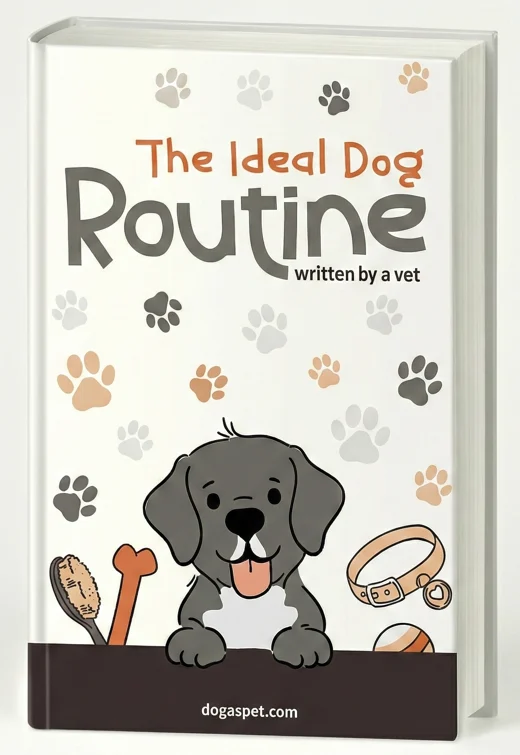
Get The Ideal Dog Routine, free
A 10-page guide written by a vet: a sample daily routine, exercise and alone time, and grooming and vet check schedules.
We'll email you the download link. Unsubscribe anytime.
Frequently asked questions
How often should I take my 8-week-old puppy out to pee?
Every time they wake up, after every meal or drink, after play, and at least every one to two hours in between while they are awake. Most 8-week-old puppies also need one or more trips during the night.
How long after eating does a puppy need to poop?
Usually soon after. Puppies often need to relieve themselves within minutes of a meal, so plan a potty break straight after each one and stay outside long enough for both a pee and a poop.
How long does it take to potty train a puppy?
Humane World for Animals says house training usually takes 4 to 6 months, and some puppies take longer. Size, age and earlier habits all play a part. Expect setbacks, especially around changes in routine.
Should I use puppy pads?
Pads can help if you live high up or are out for longer than your puppy can hold it, but they teach a puppy to go indoors, so you will need to retrain later. If you can get outside often from the start, Penn Vet notes that paper or pad training can be skipped altogether.
Why does my puppy pee right after coming back inside?
Usually the trip outside was too short or too exciting. Go out on a leash to the same quiet spot, wait without playing, and reward the moment your puppy finishes. Save play and walks for after they have gone.
Sources
Related tools
- Puppy sleep scheduleEnter your puppy's age, wake-up time and bedtime to get a daily nap schedule, total sleep and night potty alarm times.
- Crate training scheduleEnter your puppy's age (or choose adult dog) and a start date to get a dated week-by-week crate plan with the longest safe crate time each week.
- Puppy socialization checklistEnter your puppy's birth date to see how long the socialization window stays open, then tick off people, places, sounds and handling as you go.
- How long can a dog be left alone?Enter your dog's age, how used to being alone they are and your hours away to get the longest safe stretch alone and a day plan with visits.
- Daily dog routine builderEnter when you get up, go to bed and leave for work to get a timed daily schedule of walks, meals, potty breaks, training and visits.
- Dog exercise calculatorChoose a breed or energy level, age and health to get daily exercise minutes, how to split them into walks, and a puppy guide.