How long can a dog be left alone?
Enter your dog's age, how used to being alone they are, and when you leave and get back. You get the longest your dog should be alone at a stretch, how many visits your day needs, and a timed plan.
 Tim de Jong
Your dog
Settles and sleeps while you're out
Optional: if your dog needs to go more often
Barking or howling, damage, accidents, trying to escape
Max time alone at a stretch
4hours
The RSPCA and PDSA advise no more than four hours at a time, so your dog can relieve themselves, move and have company.
- You're away
- 9 h 30 min
- Visits needed
- 2
- Visit times
- 11:15 am, 2:15 pm
- Longest stretch
- 3 h 15 min
- Ready for today
- 4 hours
- Bladder (rough)
- Adult: 8 h+
Limit = the lowest of: 4 hours (RSPCA, PDSA). Visits are spaced evenly so no stretch runs over it.
Your day plan
2 visits keep every stretch at 3 h 15 min or less. A dog walker, neighbor, friend or daycare can cover them.
- 7:00 amWalkWalk or a good play sessionA tired dog settles more easily
- 7:30 amPottyHome: potty break, then a small mealBe back about half an hour before you leave
- 8:00 amAloneLeave calmly with a stuffed food toy or chewKeep goodbyes short and low-key
- 11:15 amVisitVisit 1 of 2Potty break, a short walk or play, fresh water
- 2:15 pmVisitVisit 2 of 2Potty break, a short walk or play, fresh water
- 5:30 pmPottyHome: potty break firstThen a calm hello and a walk later on
Based on RSPCA, PDSA, Penn Vet and San Francisco SPCA guidance. Dogs with health problems may need breaks more often: ask your vet.
How long can you leave a dog alone?
The RSPCA advises leaving dogs alone for no longer than four hours at a time, so they have the chance to exercise, go potty and spend time with people. The PDSA gives the same four-hour guide. That's a welfare limit, not a bladder limit: Penn Vet notes that adult dogs can usually hold their urine for 8 hours or longer, but should get the chance to go out about every four hours.
Puppies hit their limit much sooner, because bladder control comes with age:
| Dog | In a pen or room | In a crate |
|---|---|---|
| Puppy, 8 weeks | 1.5 hours | 1 hour |
| Puppy, 10 weeks | 2 hours | 1 hour |
| Puppy, 12 weeks | 2.5 hours | 2 hours |
| Puppy, 16 weeks | 3.5 hours | 3 hours |
| Puppy, 20 weeks | 4 hours | 4 hours |
| Puppy, 24 weeks | 4 hours | 4 hours |
| Adult | 4 hours | 4 hours |
| Senior | Up to 4 hours, less if they need to pee more often | Up to 4 hours |
How long can a puppy be left alone?
For a puppy, the tool takes the lowest of three numbers: the four-hour welfare limit, the bladder rule of thumb of roughly one hour per month of age (from Penn Vet, rounded down to the nearest half hour), and, if your puppy is crated, the San Francisco SPCA's daytime crate limits. The bladder rule is a convenient guide from experience rather than a measured fact, so if your puppy has accidents before the time is up, take the lower number.
Start early, in tiny doses: a few minutes in a pen with a chew while you are in the next room is a good first step. Short, calm spells alone while you are home make the first real absences much easier.
How do I teach my dog to be left alone?
The RSPCA estimates that eight out of ten dogs find it hard to cope when left alone, so this step is worth the effort. Its method is gradual:
- Ask your dog to stay on their bed while you are in the room. Reward calm.
- Move further away, then out of sight, coming back before your dog gets worried.
- Go out of the door and close it, for a few seconds at first, then longer.
- Build up slowly. Once your dog is happy alone for up to an hour, longer stretches should be manageable.
On the day, the RSPCA recommends a walk before you go, getting home about half an hour before leaving, a small meal, and a potty break, then a stuffed food toy or chew that only comes out when you leave. The PDSA adds simple practice while you are home: spend time in the yard, take a short walk, or sit in another room.
Leaving a dog alone while you work full time
Most workdays are longer than four hours. An adult dog left from 8:00 am to 5:30 pm is alone for 9 h 30 min, which needs 2 visits (11:15 am and 2:15 pm) to keep every stretch under four hours. A 12-week-old puppy in a pen over the same day, with a limit of 2.5 hours, needs 3.
Visits can come from a dog walker, a neighbor, a friend or family, or you can use daycare. If even that doesn't add up for a young puppy, the honest answer is that the first months need someone at home for much of the day. Our daily routine builder fits walks, meals and visits around your work hours, and the crate training schedule covers safe crate times.
Signs your dog isn't coping when left
The RSPCA lists the common signs of separation-related problems as destructive behavior, howling, barking or whining, and peeing or pooping indoors. Less obvious ones include trembling, panting, drooling, pacing or circling, licking paws or chewing the tail, vomiting, and not eating while alone. A camera is the easiest way to find out. If you see them:
- Stop extending the time alone and arrange company while you get help.
- Never punish your dog when you get home. Your dog can't link it to what happened earlier, and it makes the next departure more frightening.
- See your vet first to rule out pain or illness, then ask for a referral to a clinical animal behaviorist.
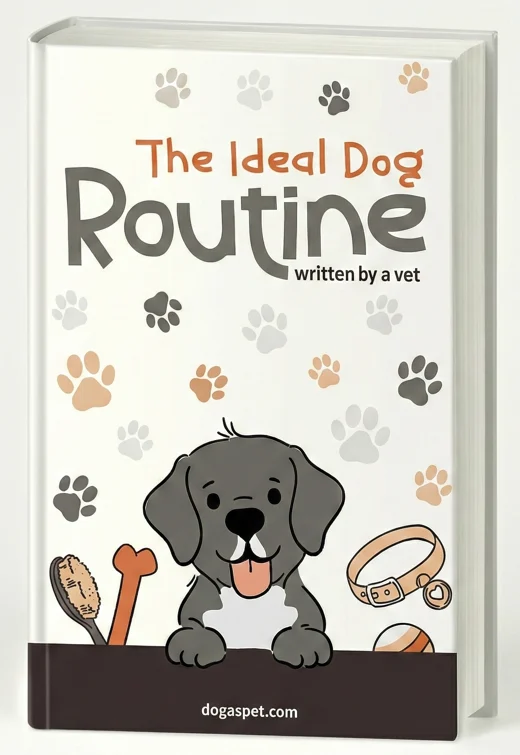
Get The Ideal Dog Routine, free
A 10-page guide written by a vet: a sample daily routine, exercise and alone time, and grooming and vet check schedules.
We'll email you the download link. Unsubscribe anytime.
Frequently asked questions
Can I leave my dog alone for 8 hours?
Not in one stretch, according to UK welfare charities: the RSPCA and PDSA both advise no more than about four hours at a time. Adult dogs can often hold their bladder for 8 hours or longer, but they also need exercise, potty breaks and company. For an 8-hour day, plan at least one midday visit, or two once you add your commute.
Is it OK to leave a dog alone overnight?
The same four-hour guidance applies, and a night alone also means nobody is there if something goes wrong. If you have to be away overnight, arrange a sitter, a friend who stays over, or boarding rather than leaving your dog on its own.
How long can an 8-week-old puppy be left alone?
Not long: about 1.5 hours in a puppy-proofed pen and 1 hour in a crate, and only once they are used to short absences. At this age bladder control is roughly one to three hours, and many puppies need to go sooner after eating, drinking or play.
What should I leave my dog with when I go out?
The RSPCA suggests a food toy such as a stuffed Kong, a treat ball or a long-lasting chew, kept only for times you are out so it stays special. Leave fresh water, a comfortable bed, and room to move away from their sleeping area if they might need to go.
How do I know if my dog has separation anxiety?
The RSPCA lists destructive behavior, howling, barking or whining, and peeing or pooping indoors as the common signs, with trembling, panting, drooling, pacing, paw licking, vomiting or not eating while alone as less obvious ones. A camera shows what happens while you are out. Talk to your vet, who can rule out medical causes and refer you to a behaviorist.
Sources
Related tools
- Puppy sleep scheduleEnter your puppy's age, wake-up time and bedtime to get a daily nap schedule, total sleep and night potty alarm times.
- Puppy potty scheduleEnter your puppy's age, wake-up time, bedtime and meals to get a daily potty timetable, how long they can hold it and night alarm times.
- Crate training scheduleEnter your puppy's age (or choose adult dog) and a start date to get a dated week-by-week crate plan with the longest safe crate time each week.
- Puppy socialization checklistEnter your puppy's birth date to see how long the socialization window stays open, then tick off people, places, sounds and handling as you go.
- Daily dog routine builderEnter when you get up, go to bed and leave for work to get a timed daily schedule of walks, meals, potty breaks, training and visits.
- Dog exercise calculatorChoose a breed or energy level, age and health to get daily exercise minutes, how to split them into walks, and a puppy guide.