Safe Toothpaste for Dogs: The 5 Best Dog Toothpastes (2026)
 Written by Tim de Jong
As an Amazon Associate we earn from qualifying purchases, at no extra cost to you. Disclosure
Pick by your dog
Swipe ›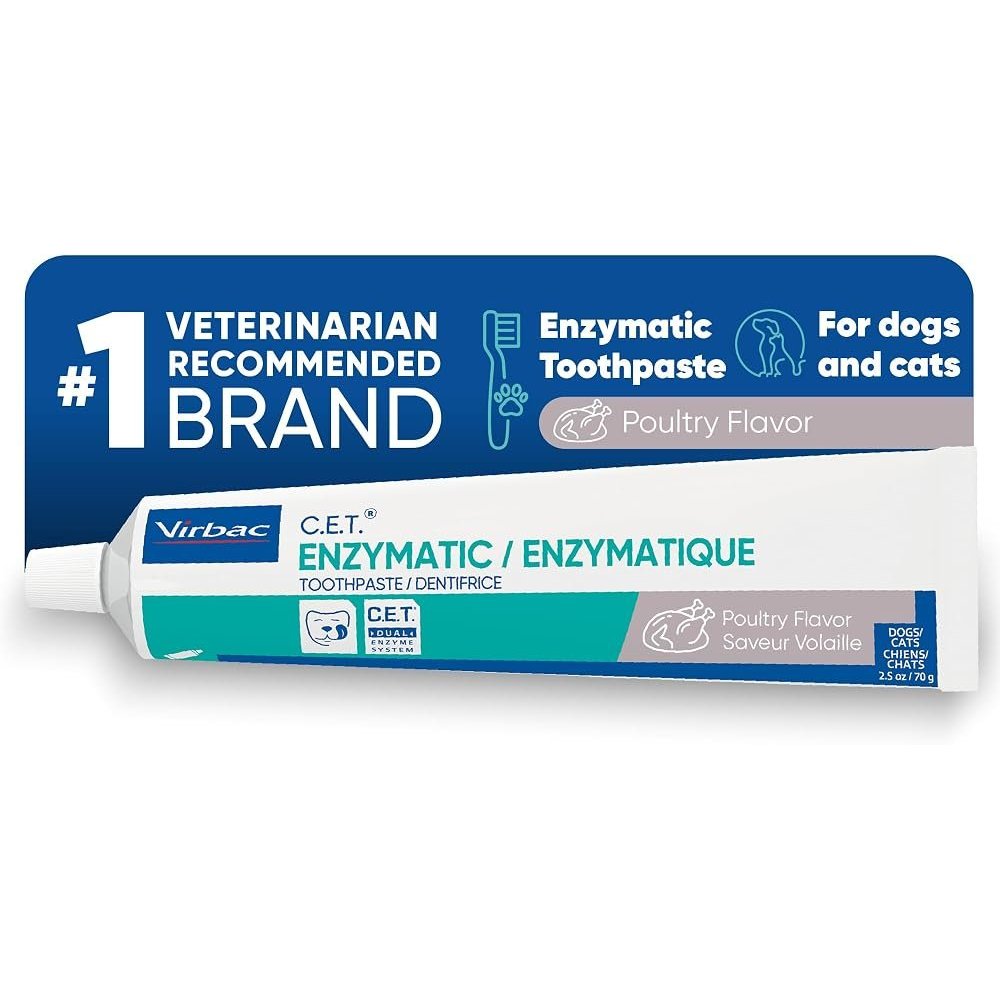
Our picks
| Pick | Best for | Buy |
|---|---|---|
| Top pickVirbac C.E.T. Enzymatic Toothpaste | Best Overall | Check price |
| Vet's Best Toothpaste & Toothbrush Kit | Best Kit for Beginners | Check price |
| Petrodex Enzymatic Toothpaste (6.2 oz) | Best Big Tube for Multi-Dog Homes | Check price |
| Vet's Best Enzymatic Dental Gel | Best Botanical Formula | Check price |
| Arm & Hammer Complete Care Enzymatic Toothpaste | Best Budget | Check price |
Dogs don't spit. Whatever you put on the brush ends up in their stomach, and that single fact is why the tube in your bathroom cabinet is off-limits and why dog toothpaste exists as its own product category.
The good news is that safe toothpaste for dogs is cheap, easy to find and tastes like chicken. The less good news is that the toothpaste matters far less than the brushing itself. Below are the five dog toothpastes we'd buy, followed by what actually makes a toothpaste safe, a step-by-step brushing routine and an honest comparison with dental chews and water additives.
The short answer: a safe toothpaste for dogs is one made specifically for pets: no xylitol, no fluoride, no foaming agents, and safe to swallow. Enzymatic pet toothpastes such as Virbac C.E.T. tick every box and are what most vet clinics sell. Never use human toothpaste on a dog, even a "natural" or children's one.
Why human toothpaste isn't safe for dogs
Human toothpaste is designed to be spat out. Three common ingredients make it a bad idea for an animal that swallows every bit of it:
- Xylitol. This sugar substitute shows up in many toothpastes, mouthwashes and sugar-free gums. In dogs it triggers a rapid insulin release that can drop blood sugar dangerously within minutes to hours, and larger amounts are linked to liver failure. Small dogs are at risk from surprisingly small amounts. If your dog got into a tube or a pack of gum, our xylitol toxicity calculator gives a quick risk estimate, but call your vet or a pet poison hotline straight away rather than waiting for symptoms.
- Fluoride. Great for human enamel in small, spat-out amounts. Dogs swallow it all, and swallowed fluoride can upset the stomach and is toxic in larger doses.
- Foaming agents and detergents. Ingredients like sodium lauryl sulfate create that foamy feel. Swallowed, they can irritate the stomach and cause vomiting or diarrhea.
Baking-soda-only "DIY toothpaste" and coconut oil recipes get shared a lot online. They're not dangerous in small amounts, but they don't do anything a proper pet toothpaste doesn't do better, and a big dose of baking soda isn't something you want your dog swallowing daily. Stick with a product made for dogs.
What makes a toothpaste safe for dogs
When you're comparing labels, look for:
- Labeled for dogs (or dogs and cats). That means it's formulated to be swallowed.
- No xylitol. Reputable pet toothpastes don't use it. Other sugar alcohols like sorbitol are common in pet toothpaste and are not considered a xylitol-type risk.
- No fluoride and no foaming agents. Look for "no-rinse" or "non-foaming" on the tube.
- Enzymatic, ideally. Enzymes such as glucose oxidase and lactoperoxidase support the mouth's own antibacterial system. They're a helpful extra on top of brushing, not a substitute for it.
- A flavor your dog likes. Poultry, beef and peanut butter are popular for a reason. A paste your dog enjoys is a paste you'll actually use.
One more signal worth knowing: the VOHC seal. The Veterinary Oral Health Council reviews trial data and awards its seal to products shown to reduce plaque or tartar. None of the five picks below advertise the seal on their listings (most toothpastes rely on the brushing to do the work), but if the seal matters to you, Petsmile Professional is sold as VOHC-accepted.
1Virbac C.E.T. Enzymatic Toothpaste
Get it if
You want the vet-clinic standard with a flavor for every picky dog.
Skip if
You also need a brush; it comes on its own.
If you ask a vet clinic for dog toothpaste, there's a good chance you'll be handed a tube of C.E.T. It's the reference product in this category: a dual-enzyme formula (glucose oxidase and lactoperoxidase) with no foaming agents, made to be swallowed, and labeled for both dogs and cats.
The poultry version is the one most dogs go for. Where C.E.T. really earns the top spot is flavor choice: it also comes in beef, malt, seafood and vanilla mint, which makes it the easiest brand to keep using if your dog turns out to be fussy. Try poultry first and switch flavors before you switch brands.
The only drawback is size. The 2.5 oz tube is small for the price, so if you have a big dog (or several) and brush daily, you'll go through it faster than the big-tube picks below.
Pros
- Vet-clinic standard, dual-enzyme formula
- No foaming agents, safe to swallow
- Five flavors, the best choice for picky dogs
- Safe for cats too, so one tube covers a mixed household
Cons
- Small 2.5 oz tube, so it costs more per ounce
- Toothpaste only; you'll need to buy a brush separately
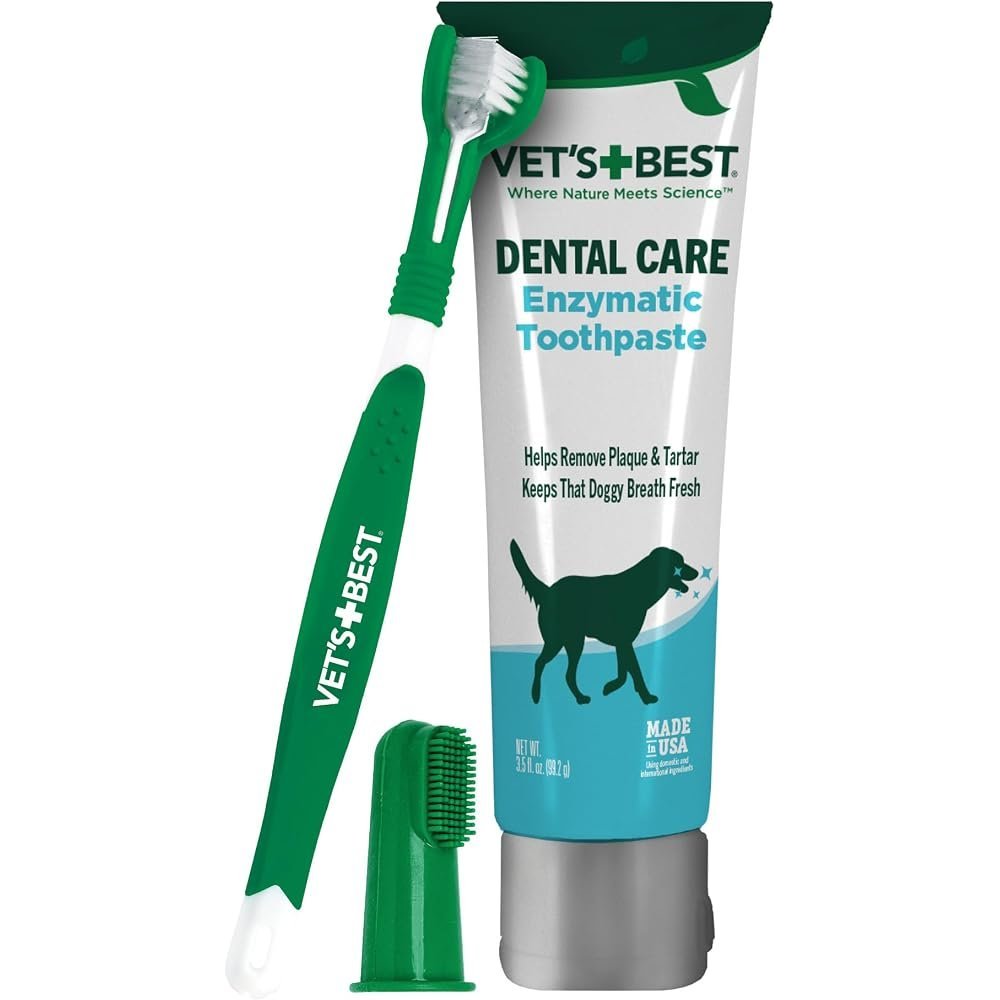
2Vet's Best Toothpaste & Toothbrush Kit
Get it if
You're starting from scratch and need paste and brush in one box.
Skip if
Your dog dislikes plant-based flavors; try a poultry paste instead.
If you've never brushed a dog's teeth before, start here. You get a 3.5 oz tube of Vet's Best enzymatic gel plus a triple-headed toothbrush that cleans the outer, inner and chewing surfaces in one pass. That matters more than it sounds: with a wriggly dog you only get a few seconds per side, and a three-sided brush covers more tooth in those seconds than a flat one.
The paste is the same gel as our #4 pick (sold on its own), with aloe, neem oil, grapefruit seed extract, baking soda and enzymes listed on the label. The angled triple-head brush cleans the outer, inner and chewing surfaces in one pass.
The triple-head brush is great on the big back teeth of medium and large dogs. On toy breeds it can be too bulky to fit comfortably, and for those dogs a finger brush or small single-head brush is the better first tool.
Pros
- Toothpaste and brush in one box at a low price
- Triple-head brush covers three tooth surfaces at once
- Huge review base
Cons
- Brush head is bulky for toy breeds and small puppies
- Botanical flavor may not win over every meat-loving dog
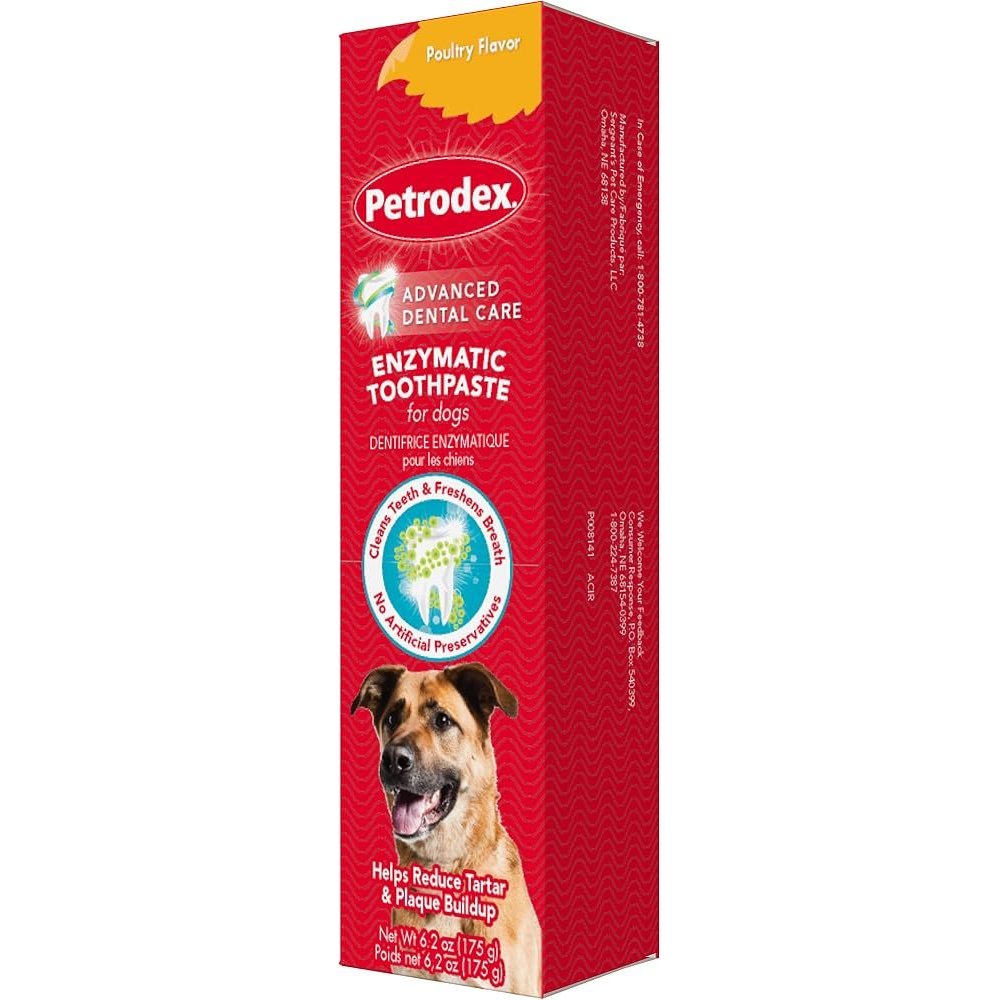
3Petrodex Enzymatic Toothpaste (6.2 oz)
Get it if
You brush several dogs and want a big tube.
Skip if
You want a choice of flavors beyond poultry.
Petrodex has been on pet-store shelves for decades, and the 6.2 oz poultry tube is the value play: more than twice the paste of a standard tube, at a price that's usually close to a small one. It's enzymatic, non-foaming and no-rinse.
The ingredient list leads with sorbitol (a sweetener that's common in pet toothpaste and not to be confused with xylitol) and includes poultry digest for flavor. It's a straightforward, proven formula. If you're brushing two or three dogs every day, this is the tube that won't run out every few weeks.
Pros
- Big 6.2 oz tube, lowest cost per brushing on this list
- Enzymatic, non-foaming, safe to swallow
- Poultry flavor that most dogs accept
Cons
- Only one flavor in the big size
- No brush included
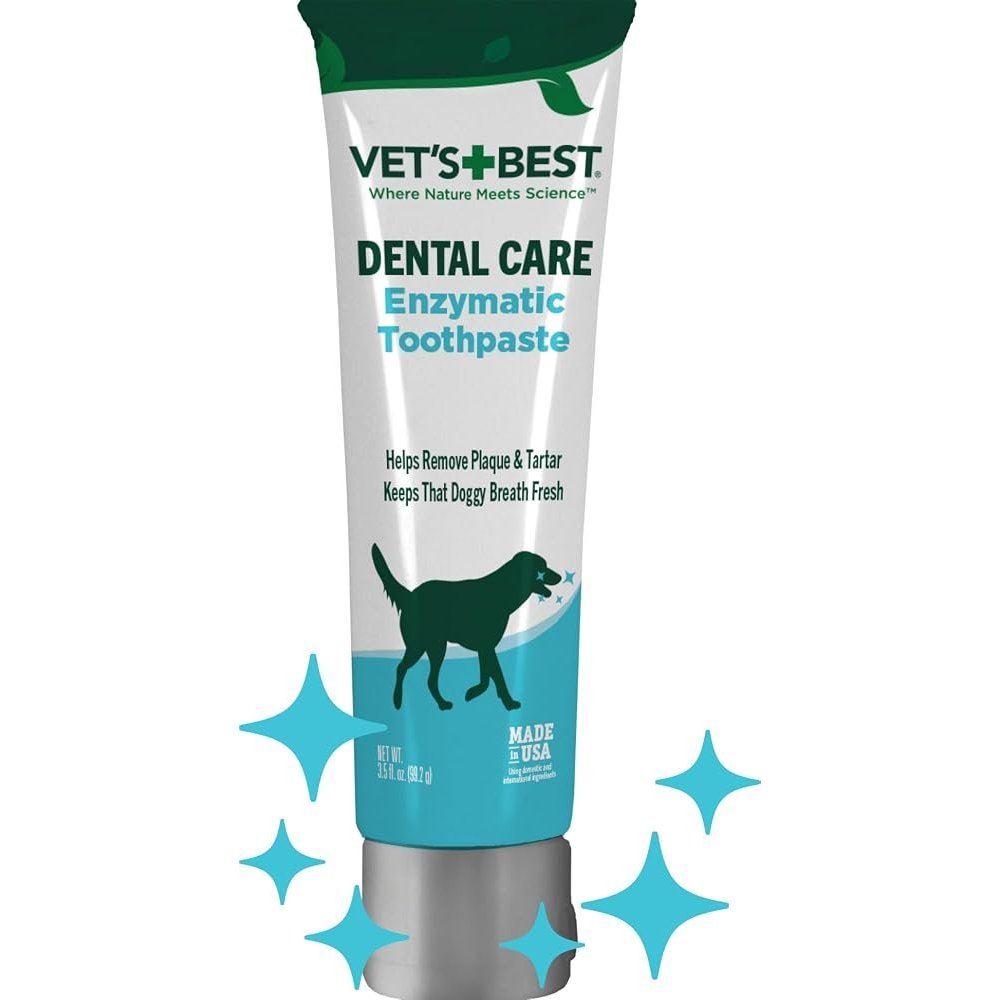
4Vet's Best Enzymatic Dental Gel
Get it if
You already own a brush and prefer a plant-based ingredient list.
Skip if
Your dog only accepts meat flavors.
Same gel as the kit above, sold on its own for when you already have a brush you like. It suits owners who prefer a plant-based ingredient list. The label lists glycerin, aloe, pectin, neem oil, grapefruit seed extract, baking soda, glucose oxidase and natural flavors, with no meat-derived flavoring listed.
The label also suggests you can rub it on with a finger, which makes it a decent "first step" paste for dogs that won't accept a brush yet. For the best result the manufacturer recommends no food or water for half an hour afterward, which is easiest if you brush at bedtime.
Pros
- Plant-based ingredient list with an enzyme
- Gel texture stays on a finger or brush
- Good price for a 3.5 oz tube
Cons
- Dogs that love meat flavors may be less keen
- Works best with a 30-minute no-food window after brushing
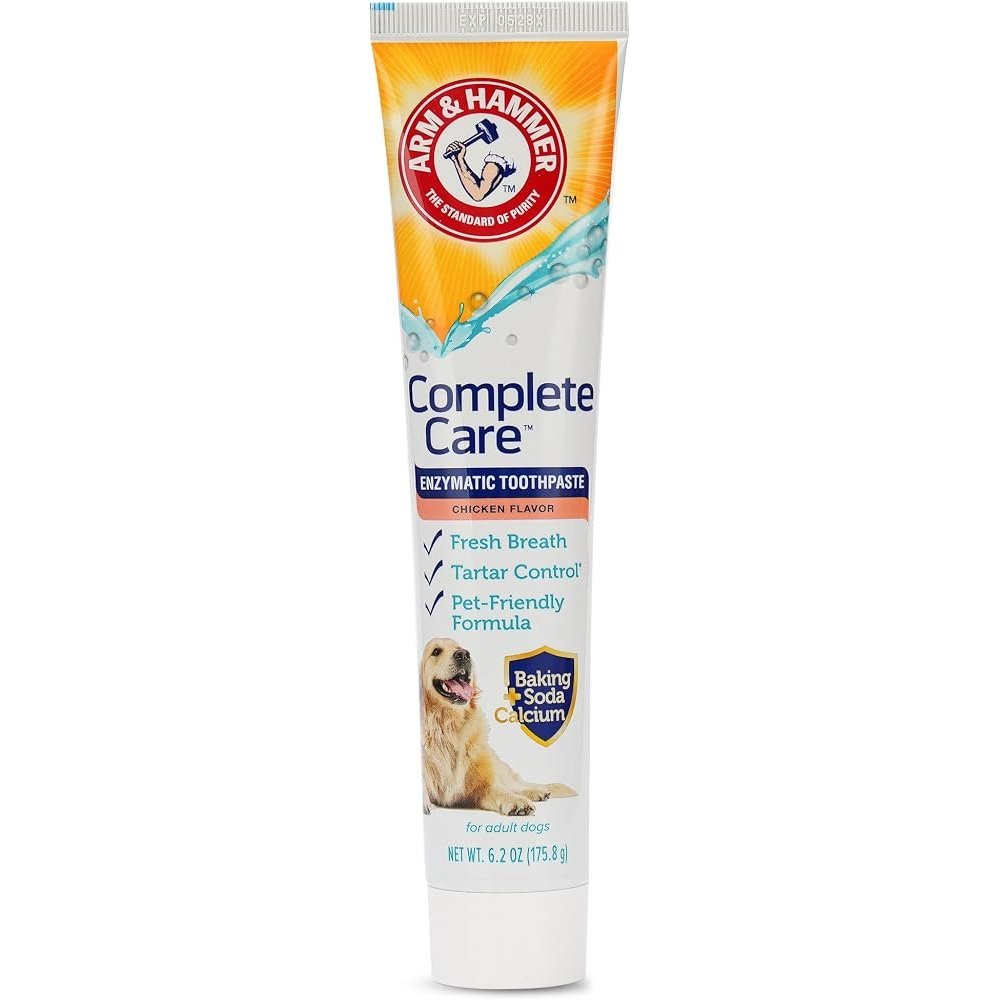
5Arm & Hammer Complete Care Enzymatic Toothpaste
Get it if
You want the cheapest name-brand enzymatic tube.
Skip if
Your dog dislikes the taste of baking soda.
Arm & Hammer's dog line is usually the cheapest name-brand enzymatic toothpaste you can buy, and the 6.2 oz Complete Care tube is the best value of the range. It combines enzymes with a small amount of baking soda for breath and added calcium, in a chicken flavor.
This is a good tube to buy when you're not sure your dog will tolerate brushing at all, because it's cheap enough that it won't hurt if the experiment fails. If brushing sticks, it's also perfectly fine to keep using long term.
Pros
- Lowest price on this list for a big 6.2 oz tube
- Enzymatic, chicken flavor
- Made for dogs, safe to swallow
Cons
- Labeled for adult dogs; there's a separate puppy version
- Fewer reviews than the other picks
How to use dog toothpaste: brushing your dog's teeth step by step
You don't need to do a perfect job on day one. The goal for the first two weeks is a dog that's relaxed about having its mouth handled.
- Pick a calm moment. After a walk, when your dog is tired, works far better than when they're wound up.
- Let them taste the paste. Put a small dab on your finger and let your dog lick it off. Do this for a day or two so the tube becomes a treat.
- Touch the teeth and gums. Lift the lip and rub a pasted finger along the outer surfaces of the front teeth, then the canines. Stop while your dog is still relaxed.
- Introduce the brush. Use a soft dog toothbrush or finger brush. Hold it at about a 45-degree angle to the gumline and use small circles.
- Focus on the outside surfaces. The outer faces of the upper back teeth (the big premolars and molars) collect the most tartar. Your dog's tongue keeps the inner surfaces cleaner, so don't fight to get inside.
- Build up to about 30 seconds per side. Add a few teeth each session. A full mouth should take one to two minutes once your dog is used to it.
- Reward. Praise or a play session afterward. Many dogs treat the toothpaste itself as the reward.
Expect a little pink on the brush in the first week if the gums are already inflamed. Bleeding that continues or is heavy is worth a vet check, and we cover the possible causes in why your dog's gums bleed when brushing. If your dog fights the brush no matter what, see our guide on how to brush a dog's teeth that hates being brushed.
How often should you brush your dog's teeth?
Daily is the goal. Plaque starts forming on a clean tooth within hours and can begin hardening into tartar within a few days, so brushing every day keeps ahead of it. Veterinary dental guidance treats daily brushing as the gold standard for home care.
If daily isn't realistic, three times a week is a reasonable minimum, and it's still far better than nothing. What doesn't work is brushing once a fortnight. By then plaque has had time to mineralize, and once it's tartar, no toothpaste or brush will remove it.
Toothpaste vs. dental chews vs. water additives
All three get marketed as "dental care", but they aren't equal:
- Brushing with dog toothpaste is the most effective thing you can do at home. The mechanical scrubbing does most of the work, and the paste makes it more pleasant and adds a bit of enzyme action.
- Dental chews help through chewing action, and some carry the VOHC seal. They're a good add-on, especially for dogs that won't tolerate brushing. Watch the calories (they count toward your dog's daily intake), and supervise chewing.
- Water additives are the easiest option but the least powerful. Some are VOHC-accepted for plaque or tartar, and they can help with breath. Introduce them gradually, since some dogs drink less if the water tastes different.
Breath treats fit in the same "helpful extra" category. We compare the options in our best dog treats for bad breath roundup.
None of these remove tartar that's already there. Hard, brown buildup along the gumline needs a professional cleaning under anesthesia, where the vet can also clean below the gumline and X-ray the roots. If that's coming up, we've covered dog teeth cleaning anesthesia side effects and what recovery looks like.
When to see a vet instead
Toothpaste is prevention, not treatment. Book a vet visit if you notice:
- Bad breath that doesn't improve with a couple of weeks of regular brushing
- Red, swollen or bleeding gums
- Visible brown or yellow tartar
- Loose, broken or discolored teeth
- Dropping food, chewing on one side, or pawing at the mouth
- Facial swelling, especially under the eye
FAQ
What toothpaste is safe for dogs?
Toothpaste made for pets. A safe toothpaste for dogs contains no xylitol, fluoride or foaming agents and is designed to be swallowed. Enzymatic dog toothpastes like Virbac C.E.T., Petrodex, Vet's Best and Arm & Hammer's dog range all meet that standard.
Can I use human toothpaste on my dog?
No. Human toothpaste can contain xylitol, which is toxic to dogs, along with fluoride and foaming agents that aren't meant to be swallowed. If your dog has eaten human toothpaste, check the label for xylitol and call your vet or a pet poison hotline.
1Is baking soda safe for dogs' teeth?
Small amounts, like those in some commercial dog toothpastes, are fine. Brushing with straight baking soda isn't recommended. It tastes bad to most dogs, adds little cleaning benefit, and swallowing larger amounts regularly isn't a good idea.
2Do I need to rinse after using dog toothpaste?
No. Pet toothpaste is made to be swallowed, so there's nothing to rinse. Some brands suggest holding off food and water for about 30 minutes afterward to let the paste work longer.
3What's the best toothpaste for puppies?
Any enzymatic pet toothpaste that's labeled safe for puppies works. A mild flavor and a finger brush make the introduction easier. Starting young, even before all the adult teeth are in, is the easiest way to raise a dog that accepts brushing for life.
Can dog toothpaste remove tartar?
Not once it has hardened. Brushing removes soft plaque before it turns into tartar. Existing tartar has to be removed by your vet during a professional dental cleaning.
Final thoughts on the best dog toothpaste
For most dogs, Virbac C.E.T. is the one to buy: it's the vet-clinic standard, it's safe to swallow, and with five flavors you're likely to find one your dog likes. If you're starting from scratch, the Vet's Best kit gets you paste and brush in one box. And if you're brushing several dogs, the big Petrodex or Arm & Hammer tubes keep the cost per brush low. Whichever you pick, the paste matters less than the habit, so brush daily if you can and at least three times a week if you can't.
Get The Ideal Dog Routine, free
A 10-page guide written by a vet: a sample daily routine, exercise and alone time, and grooming and vet check schedules.
We'll email you the download link. Unsubscribe anytime.