Dog Years To Human Years (Calculator)
Dogs age much faster than humans do, on average. But just how fast is their aging process compared to ours? This calculator uses the size-based aging method from the American Kennel Club (based on AVMA guidelines), adapted to account for how different dog sizes age at different rates. Research from the National Institutes of Health confirms that dog aging varies significantly by size. Just enter in your dog's details and see the results!
Calculator
Enter your dog's details below
Enter details to see result
Supported Dog Breeds
Calculate age in human years for these popular dog breeds:
- Labrador Retriever (large breed, average lifespan 10-12 years)
- German Shepherd (large breed, average lifespan 9-13 years)
- Golden Retriever (large breed, average lifespan 10-12 years)
- French Bulldog (small breed, average lifespan 10-12 years)
- Bulldog (medium breed, average lifespan 8-10 years)
- Beagle (small breed, average lifespan 12-15 years)
- Poodle (Standard) (medium breed, average lifespan 12-15 years)
- Rottweiler (giant breed, average lifespan 8-10 years)
- Yorkshire Terrier (small breed, average lifespan 13-16 years)
- Boxer (large breed, average lifespan 10-12 years)
- Dachshund (small breed, average lifespan 12-16 years)
- Siberian Husky (medium breed, average lifespan 12-15 years)
- Great Dane (giant breed, average lifespan 7-10 years)
- Doberman Pinscher (large breed, average lifespan 10-12 years)
- Shih Tzu (small breed, average lifespan 10-18 years)
- Miniature Schnauzer (small breed, average lifespan 12-15 years)
- Pomeranian (small breed, average lifespan 12-16 years)
- Chihuahua (small breed, average lifespan 12-20 years)
- Cocker Spaniel (medium breed, average lifespan 10-14 years)
- Pit Bull (medium breed, average lifespan 12-16 years)
Age Comparison by Size
How many human years is one dog year?
Ever wondered about your dog's age in human years? Well, almost all of us do at some point or another. After all, our furry friends are such an important part of the family that it's only natural to want to know how old they are in relation to us.
Contrary to popular belief, dogs do not age at a rate of 7 human years per dog year. According to research from the National Institutes of Health, the aging process is much more complex and varies significantly based on your dog's size. NIH researchers confirm there is an "inverse relationship between skeletal size and longevity in dogs"—meaning smaller dogs live longer and age slower than larger breeds.
Size-Based Age Conversion Method
This calculator is based on American Kennel Club guidelines, which reference the American Veterinary Medical Association (AVMA) formula. We've adapted it to account for size-based variation:
- First year: 15 human years for a medium-sized dog
- Second year: An additional 9 human years (total of 24 human years at age 2)
- Each year after: Approximately 4-7 human years depending on size
Note: This is a general guideline used by veterinarians. The original AVMA formula used 5 human years per year for medium-sized dogs after age 2; we've adapted this to reflect the well-documented difference in aging rates between small (4 years), medium (5 years), large (6 years), and giant (7 years) breeds.
Why Size Matters
Dog's age at different rates depending on their size. Our calculator adjusts for this important factor:
Dog Age vs Human Age Comparison
How different dog sizes age over time
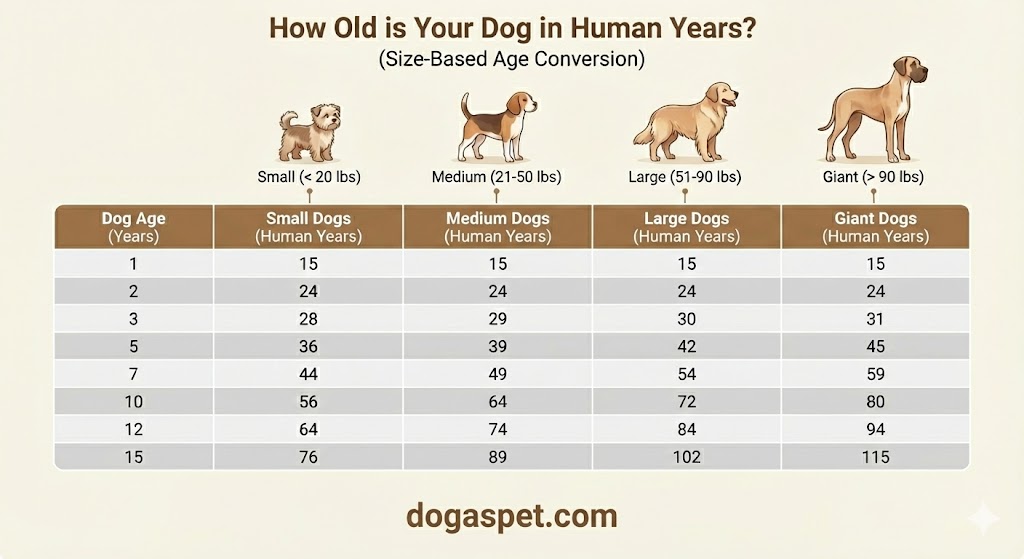
Dog Age to Human Years Conversion Data
| Dog Age (Years) | Small Dogs (Human Years) | Medium Dogs (Human Years) | Large Dogs (Human Years) | Giant Dogs (Human Years) |
|---|---|---|---|---|
| 1 | 15 | 15 | 15 | 15 |
| 2 | 24 | 24 | 24 | 24 |
| 3 | 28 | 29 | 30 | 31 |
| 5 | 36 | 39 | 42 | 45 |
| 7 | 44 | 49 | 54 | 59 |
| 10 | 56 | 64 | 72 | 80 |
| 12 | 64 | 74 | 84 | 94 |
| 15 | 76 | 89 | 102 | 115 |
This data shows that small dogs age approximately 4 human years per year after age 2, medium dogs age 5 years per year, large dogs age 6 years per year, and giant breeds age 7 years per year after reaching 2 years old.
- Small dogs (under 20 lbs): Age approximately 4 human years per year after age 2
- Medium dogs (21-50 lbs): Age approximately 5 human years per year after age 2
- Large dogs (51-90 lbs): Age approximately 6 human years per year after age 2
- Giant dogs (over 90 lbs): Age approximately 7 human years per year after age 2
Larger breed dogs tend to have shorter lifespans and are often considered senior when they are 5 to 6 years of age, while small dogs are generally considered senior at seven years old.
Understanding your dog's age in human years can help you and your veterinarian provide the best care as they age, ensuring they get appropriate exercise, nutrition, and health screenings for their life stage.
Frequently Asked Questions
How accurate is the 7-year rule for dog ages?
The popular "7-year rule" (multiply your dog's age by 7 to get human years) is not accurate. According to NIH researchers, this equivalency is "misleading and has been consistently dismissed by veterinarians." The more accurate method, endorsed by the American Kennel Club and based on AVMA guidelines, recognizes that dogs age much faster in their early years and the rate varies significantly by size. The first year of a dog's life equals approximately 15 human years, the second year adds about 9 years, and subsequent years add 4-7 years depending on the dog's size. The 7-year rule oversimplifies this complex aging process and can lead to inappropriate care decisions.
Do small dogs really age slower than large dogs?
Yes, small dogs age slower than large dogs after the first two years of life. While all dogs reach adulthood at approximately the same rate (around 2 years), larger dogs age faster in their adult years. NIH research confirms there is an established "inverse relationship between skeletal size and longevity in dogs." Larger dogs experience accelerated cellular aging and are more prone to age-related diseases earlier in life. After age 2, small dogs age approximately 4 human years per year, while giant breeds age approximately 7 human years per year.
When is my dog considered a senior?
The age at which a dog is considered senior varies significantly by breed size:
- Small dogs (under 20 lbs): Senior at 10-11 years
- Medium dogs (21-50 lbs): Senior at 8-10 years
- Large dogs (51-90 lbs): Senior at 8-9 years
- Giant dogs (over 90 lbs): Senior at 6-7 years
Dogs are generally considered senior when they reach the last 25% of their expected lifespan. Once your dog reaches senior status, they should have more frequent veterinary checkups (twice yearly instead of annually) and may benefit from senior-specific nutrition and supplements. Learn more about senior pet care from the AVMA.
How do I calculate my mixed breed dog's age?
For mixed breed dogs, follow these steps to estimate their age in human years:
- Estimate adult weight: If your dog is fully grown, use their current weight. If they're still growing, ask your veterinarian to estimate their adult size.
- Determine size category: Categorize them as small (under 20 lbs), medium (21-50 lbs), large (51-90 lbs), or giant (over 90 lbs).
- Use the size-based formula: Apply the AKC/AVMA-based formula: First year = 15 human years, second year = 9 human years, then add 4-7 years per dog year based on their size category.
Our calculator above makes this easy—simply select your mixed breed's size category and enter their age for an accurate estimate. If your mixed breed has characteristics of multiple size categories, use the middle ground or consult your veterinarian for guidance.
Why do different sources give different dog age calculations?
You may find varying dog age calculations because different sources use different methodologies. Some outdated sources still use the 7-year rule, while modern research recognizes that dog aging is not linear. The size-based method used in our calculator accounts for the rapid aging in the first two years and size-based variation thereafter, which aligns with NIH findings on the inverse relationship between dog size and longevity. Additionally, some recent research has proposed logarithmic formulas based on DNA methylation patterns (epigenetic clocks), but these don't account for size differences and remain less practical for everyday use.
Does breed affect aging beyond size?
While size is the primary factor in aging rates, specific breeds can have unique health considerations that affect their quality of life at different ages. For example:
- Brachycephalic breeds (Bulldogs, Pugs) may experience breathing difficulties earlier
- Large, deep-chested breeds are prone to bloat in middle age
- Giant breeds like Great Danes often develop joint issues younger than other dogs
- Some small breeds like Chihuahuas are known for exceptional longevity
While our calculator uses size as the primary factor, knowing your dog's specific breed helps you anticipate and prevent breed-specific health issues as they age.